

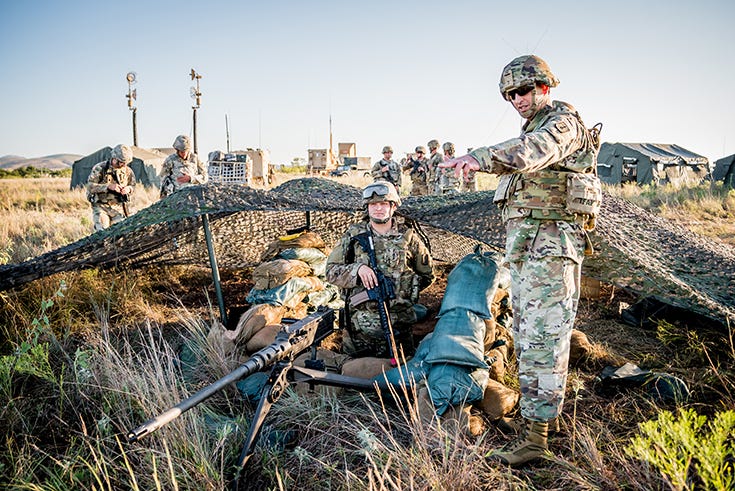
(U.S. Army photo by Sgt. Amanda Hunt taken Sept. 11, 2019) U.S. Army Command Sgt. Maj. Giancarlo Macri, 31st Air Defense Artillery Brigade, provides guidance and motivation to a Soldier conducting field training at Fort Sill, Oklahoma.
As an experienced soldier having gone through all levels of Army PME for my rank, I was confident in my communication skills. To me, effective communication was all about being direct. With over 30 years as a military leader, I considered myself a communication expert. However, delving into my recent exposure to an approach to a method of communication labeled as “motivational interviewing” and learning and using its techniques revealed that I had previously only scratched the surface of good communications.
It’s no secret that communication is the greatest challenge for any organization. Effective communication can make or break a mission, hinging on the comprehension and understanding of the message for bit the sender and the receiver. Practical and empathetic, motivational interviewing offers techniques to overcome filters and barriers in human language and delivery.
Motivational interviewing uses four key communication skills that support and strengthen the process of eliciting change talk, also known as OARS:
· Open-ended questions
· Affirming
· Reflective listening
· Summarizing
The use of open-ended questions that prompt thoughtful responses, using affirmations that boost value and confidence, reflections or back briefs to ensure clarity, and summaries that confirm mutual understanding. That is the bedrock of MI.
Motivational interviewing is a structured technique for discussing change. It’s a guided communication style that emphasizes good listening and respectfully offering advice. Instead of relying on external pressure, motivational interviewing aims to empower individuals who are resistant, hesitant, or just beginning their journey of change by tapping into their internal motivation. Its effectiveness stems from key principles: expressing empathy, rolling with resistance, developing discrepancy, and supporting self-efficacy.
I recall counseling sessions with soldiers where I felt I had done everything possible to make the sessions successful, meaningful, and productive. I believed I provided them with a clear roadmap to success, and it was up to them to follow through. On the flip side, I remember leaving counseling sessions with my leaders feeling like nothing substantial had been achieved. One take away is that MI strategies do not ask IF a person is motivated, but instead, WHAT motivates them.
Through motivational interviewing, I realized that there were many ways that communication as both the sender and the receiver could have been a more effective. In the end I may have been just a bit better leader to my soldiers, and a more receptive soldier to my leaders through better understanding the message they were trying to send me.
Implementing the principles of motivational interviewing would have helped me become more empathetic rather than directive. In hindsight, I realize I didn’t always take the time to understand what my soldiers were going through or how their experiences differed from my own. I needed to acknowledge their feelings and offer support and encouragement tailored to their unique skills and circumstances.
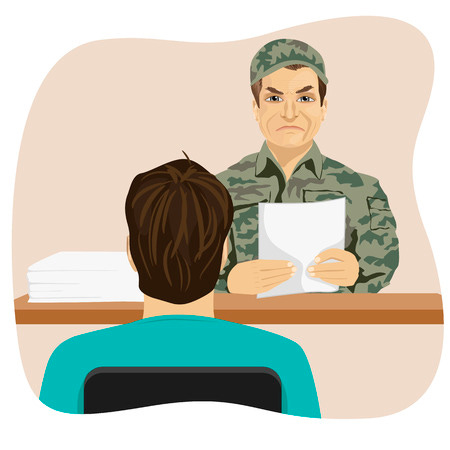
Whenever the word “counseling” was mentioned, it was assumed something negative would follow. Many times both my soldiers and I dreaded these sessions, aiming to get through them with minimal discomfort. Our mindset was more about “how do we get this over with?” rather than “how can I change behavior or attitude?” This is where rolling with resistance would have made a significant difference. Instead of focusing solely on areas for improvement, we could have identified problems and solutions together, considering multiple viewpoints rather than defaulting to “because I said so” or “that’s the way we do it here.”
Motivational interviewing has taught me that people are more likely to make lasting changes when they articulate their reasons and plans for change. Military counseling has traditionally involved predefined objectives with little input from the soldier, resulting in one-size-fits-all counseling forms. For a successful interaction in a military context, the soldier being counseled needs to do most of the talking.
As a lifelong learner, I now see that had I taken the time to ask and genuinely listen to the soldiers’ future goals based on their current circumstances, it would have been much easier to support and guide them. This could have been achieved by allowing the soldier to lead the conversation through open-ended questions, encouraging them to reflect on how their current actions and behavior would affect their future goals. This approach helps maintain a positive trajectory or steer away from a negative one. When soldiers realize discrepancies in their goals through conversation, it has a much greater impact than a leader dictating their goals and providing a plan based on personal experience.
In the U.S. Army, some organizations are dabbling in and using the principles of motivational interviewing. This helps provide essential training to equip the next generation of leaders with advanced communication and problem-solving techniques. By learning to master these techniques now todays leaders might have new tools on how to better navigate and address challenges more effectively than my generation did.
CSM (Ret.) Philip Johndrow,
Soldier for Life

Thanks for sharing.