

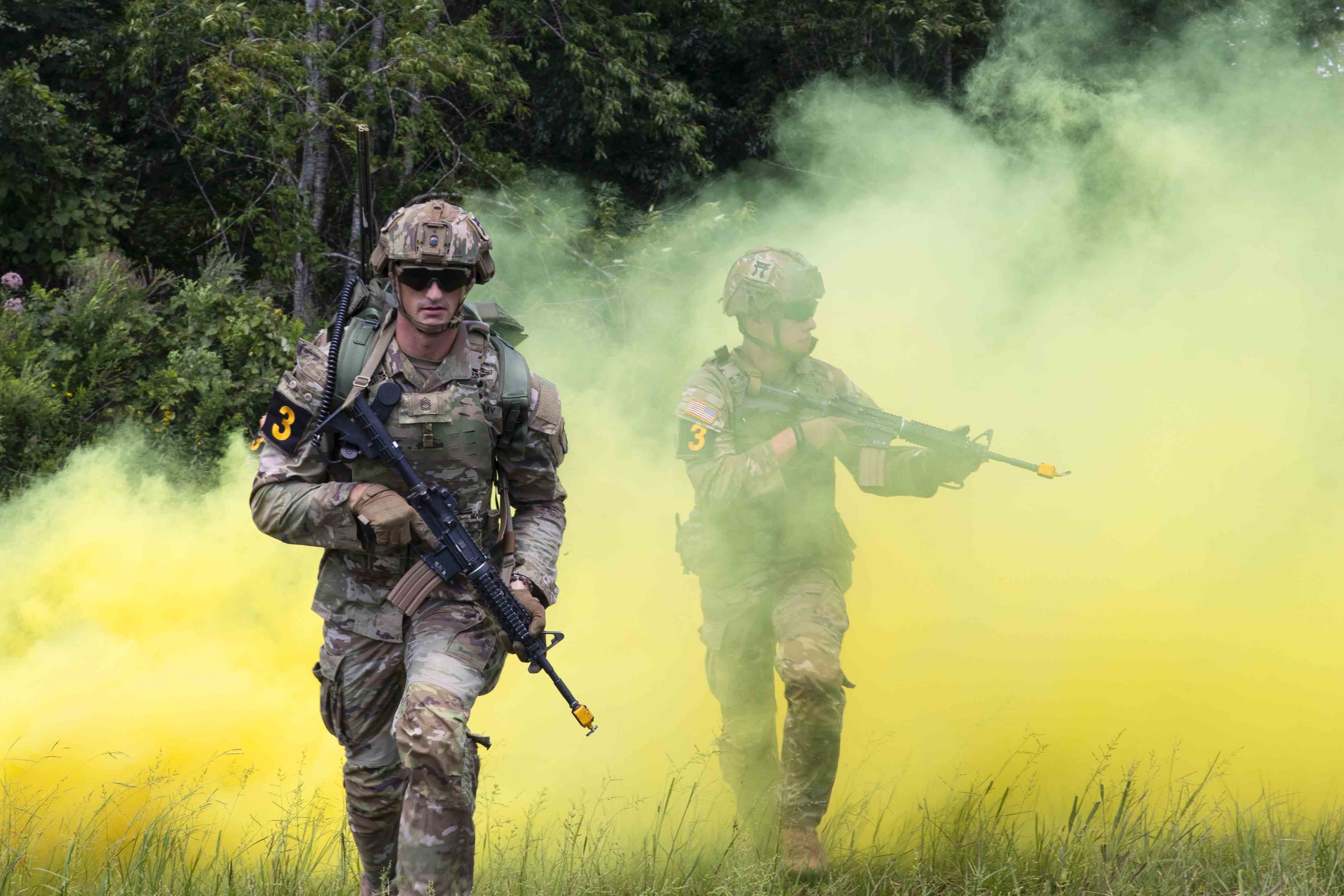
Army Sgt. 1st Class Cody Beadle, left, and Spc. Dustin Feldner compete in the U.S. Army Forces Command Best Squad Competition at Fort Campbell, Ky., Aug. 17, 2023. (U.S. Army photo by Spc. Jaidon Novinska) Credit U.S. Army.
Last year there was a lot of hoopla about the 50th anniversary of the All-Volunteer Army with nary a word about the bigger news story, that being the birth of the Enlisted Personnel Management System (EPMS). Before its implementation in 1973, the program that coincided with the abolishment of the draft, was the beginning of the first time implementation of an overarching management system for the career enlisted force, that being the sergeants and specialists of the U.S. Army.
Prior to Vietnam the Army did not have career management fields, centralized and semi-centralized promotions, a quality management (up or out) program, or any professional military education (PME) of any substance. But more importantly, as those programs were created in the wake of the war, they were delinked and not connected to an overarching career management pathway to selection, promotion and assignment based on attainable measures. Enlisted management was a shambles and had been decentralized and not well suited to attract and retain the best talent. The architects of EPMS knew to sustain the volunteer Army it had to do better. So, for most of the 1970s, some of the best initiatives to ever affect the enlisted force were woven together to create EPMS, and created the Army of the next century, and was to help sustain the volunteer force into the future.
So what happened, why is the Army struggling to recruit and retain career enlisted soldiers if EPMS was to boost the prestige of serving the NCO Corps?
It’s easy to sit around and wring our hands about the cause and effect of this program here or that program there, and I am under no illusion that the symptoms are vast and significant. Personally, my view is that the three biggest new reasons that are influencing recruiting problems are 1) shrinking labor market, 2) loss of prestige and trust in serving in the military, 3) and overly restrictive qualifications to serve. And one of the biggest headaches facing recruiters today is Genisis. Before technology advancements military entrance medical personnel could not see back to a kindergartener’s diagnosis of ADHD that they outgrew in high school. Today it could be disqualifying. These days every energetic kid seems to be labeled as on the spectrum and medical people pushing meds. It seems right now 13 years old is a cut line, it's a difficult challenge for recruiters later in a kid’s life to enlist in the Army if they were diagnosed or on meds even if they grew out of it. That is just one of my top three, but each could be its own post at length, ad nauseum. But recruiting problems are not necessarily retention or career problems.
Getting back to EPMS and its importance, it still is relevant and a great need, but it has lost some of the underpinnings that helped retain talent in all pay categories (Os, Es and WOs), and that is the erosion of benefits packages. Since EPMS was implemented, let’s say 1979 at the latest, that some of the anchors that kept men and women in military service were the tangibles. They weree tangible then and are of lesser value today in the current economy and labor market. So, things like health care, retirement eligibility at 20 years, the GI Bill (with no thanks to ‘Sonny’ Montgomery), those career incentives have atrophied significantly and are affecting decisons to stay or not. Which puts us right into a do-loop related to EPMS. That being, of the talent that remains, it is imperative to manage quality, promotions, evaluations and assignments of what you have. The 100-thousand-dollar question to ask is, does today’s EPMS reflect the modern career expectations of todays NCOs and the needs of the Army, and which way will the Army swing to balance between the two opposing forces?
Massive changes were required to the enlisted force able to enable it to endure the significant challenges expected of Air Land Battle and the Big 4 systems. It took a many years-long approach to create and integrate new enlisted personnel management initiaives, and that all began with the release of the 1968 study of the enlisted grade structure. The framework developed, then led to, a revolution in enlisted personnel management for the times, and has not been duplicated since. Consider the mandated Talent Management task force created generally to affect the officer and civilian corps, yet no such mandate was directed to the enlisted cohort. Not that a anyone likes working under mandate, but a curosry word search of the Combined Arms Center Talent Management Concept of Operations for Force 2025 and Beyond showed 5 instances of the term “enlisted,” and one of NCO or noncommissioned. Dont get me wrong, many great enlsited leader initives have come to fruition in the post 9/11 era, but most anyone at the operational level of leadership knows of the weak spots that exist in the noncommissioned officer development systems of 2024, and this is where the rubber meets the role in the operational forces.
Why no Call to Arms on par with the EPMS Task Force?
By scale, a significant number of recruiting shortages show themselves in the junior enlisted ranks, and retention shortfalls show in the NCO cohort. Enlisted personnel make up 79% of today’s active force, over 365,000 men and women according to Army demographic data. Almost half of the enlisted force, 1750,000, are sergeants to master/first sergeant, not accounting for the corporal E-4s. Conversely, there are less than 50k captains and below. For sure recruiting has a laser beam focused on every aspect of the systems that influence America’s youth to want to serve, but where is the comparable effort to analyze the systems and their interrelationships for the noncommissioned officers, and what, if any, changes need to be made for the next generations of the career enlisted force?
We have had a few rounds of the Year of the NCO and slogans are good for rallying the troops, but EPMS didn’t have a tagline or a marketing campaign, but real and significant change that carried the Army through the troubled transition to an all-volunteer force, through the build-up of the 1980s and to successes of Desert Storm, and back to the region in the post 9/11 era. The architects meant for EPMS to shape the next generation of enlisted soldiers and it has served us well into its 50th year, but its age is showing. It begins by analyzing the functions of the NCO corps like the Army did in 1968. Starting with Army Command Policy and a reexamination of the functions of the noncommissioned officer support channel, along with reviewing the fundamentals of the noncommissioned officer at each echelon, and their core purpose. It is time now to shine the laser beam back onto the professional development of the career enlisted force and evaluate if the expected skills, knowledge and behaviors of each enlisted grade at each duty position, are right for the times, and do the management systems support the development at each level to meet the Army’s current and future needs.
Do you have some ideas on what needs tweaking, or how to improve on existing NCO management or professional development systems? I would be glad to hear your thoughts, drop me a note in the comments below.