

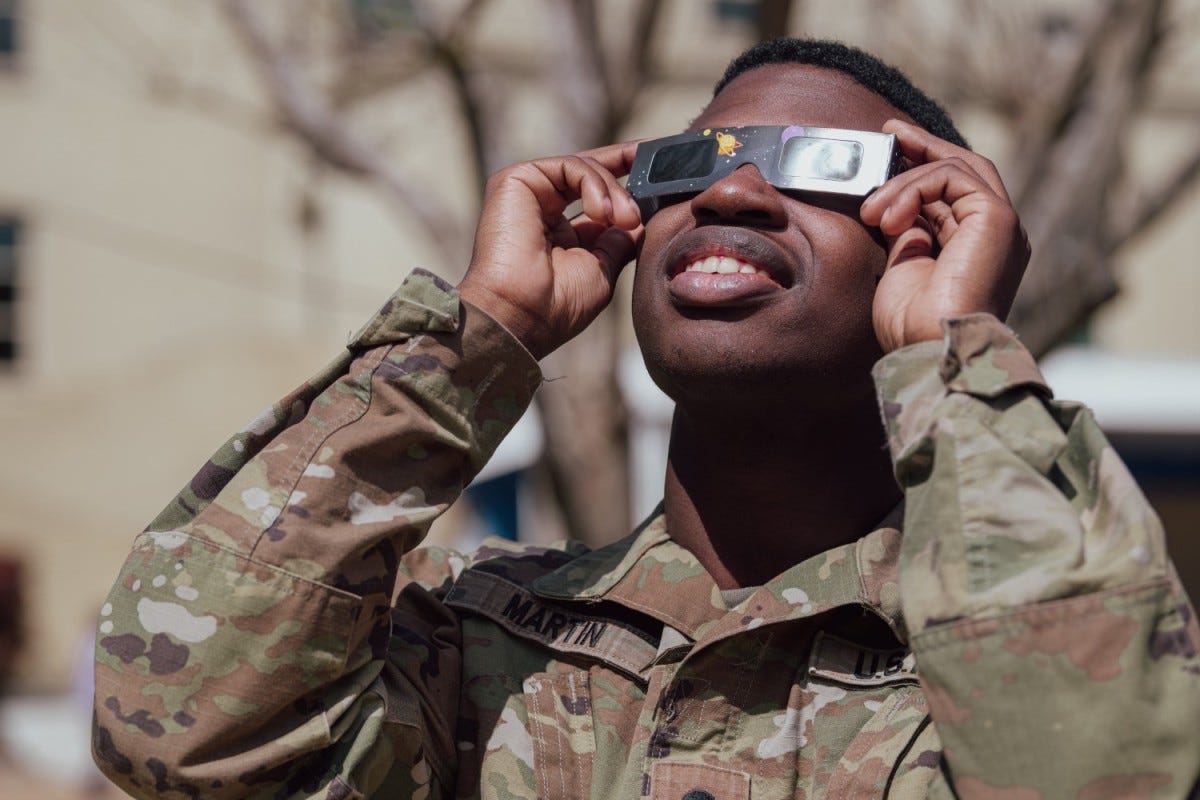
U.S. Army Spc. Joseph Martin takes a break from work to witness a partial solar eclipse over the Pentagon in Arlington, Va., April 8, 2024. (U.S. Army photo by Cpl. Aaron Troutman)
I was recently asked to reflect on my career and share some experiences that I had gathered though my years of service both in and out of uniform. Like me, many assume that after one has a whole lot of birthdays that along the way we pick up a thing or two that we might be able to share with others, especially words of advice tinged with a few drops of wisdom. I thought about the term wisdom, and it took me on a roller coaster of a ride of my own experiences, good and bad. What were impactful words that I could use to leave with a current generation of professional leaders that might want to cause them to look inward and consider their current path, and answer if the journey they are on is true? I am not sure that this stream of consciousness is, but it did get me thinking.
For a time in my career after I reached the top of the promotion ladder, I picked up a phrase that I thought would keep me “grounded” and not too egotistical. In describing my evolving leader development, I would sometimes say that I felt like by then I was a pretty “great platoon sergeant.” In my own minds eye, I figured I was professing that I was still growing and developing, and I was being humble in front of others and not being “too full of myself.” That was until I heard a couple of officers discussing a guest speaker during an OPD they had just heard from. A general had told a similar humorous anecdote that they had “only gone to West Point to play football,” and then went on to hammer home some long forgotten point. But in hearing their discussion of leaders what they expected of them, that being that they wanted what everyone expects of their leaders, to be confident and competent. And by that stage of their career to possess a unique sense of wisdom that only comes with experience, not an “awe shucks” approach to the profession. I saw myself in their discussion.
My problem was that I assumed wisdom was being right, paired with the judgment to take appropriate action. You know, be smart, have all the right answers, when in change, take charge kind of stuff. I think I was pretty good at most of that, but hearing how the message was translated from a leader to the led reminded me that those we serve expect more from leaders in positions of authority. Those officers expected more of their senior leaders, as I realized so did probably those I led. They did not want to think my experience or knowledge was two grades below my actual grade (it wasn’t), but if that is my messaging what else would they be led to believe?
I had a reminder of that just this week when lost in thought about my own needs in a moment were not on par with a fellow worker who I had unintentionally dismissed leaving them thinking their words were not important, and that I did not value them as part of a team. Which to me in the moment was not the case but may have been in the way one describes lifelong experience. Even with all the birthdays sometimes lessons have to be relearned, but now today I have the foresight to tackle it head on and own the mistake and demonstrate compassion in how to address my errors and make amends. That is the difference from my previous self that demonstrates wisdom.
Sociologist Monika Ardelt suggested that one develops wisdom through reflection, compassion, and the pursuit of truth. In thinking about how one can cultivate that in themselves the biggest lesson I could share with anyone who would listen is that I was a latecomer to reflection and compassion. Growing up in the 1980s in an organization whose culture was surrounded by a warrior ethos in a male dominated society that separated classes of people was what shaped me, and the leaders who also were products of the same. As society today fights some of the same battles of class, gender, race and religion that creates a DMZ between groups, it seems for every step forward are equal steps backward. But an area that I continue to see a shimmering sign of hope and true change to that culture is more acceptance to widespread adoption of compassion, and leaders unafraid to self-reflect.
When asked to speak on topics I usually share a bit of the good, the bad, and the ugly, and in reflection I always hope to impart a lesson that can be applied to the reader or listener’s knowledge bank. For current and future leaders, the pursuit of truth of oneself is an important lesson to learn early in your journey, and don’t wait too long for that to set in. The expectation of the people you lead may not to put you on a pedestal but to endear yourself to them, but do that in your professionalism and compassion, not in cute stories or phrases. Maybe one day I will have it all figured out, but still today, I must keep on learning.
I look forward participating.