

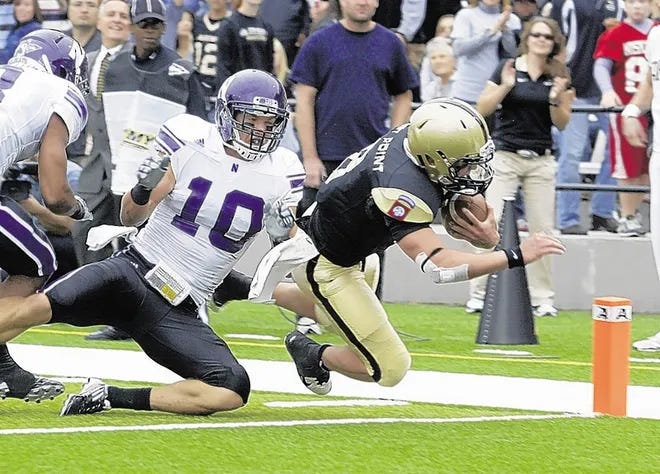
Army quarterback Trent Steelman (#8) dives into the end zone for a 1 - yard touchdown in the first quarter of their game against Northwestern in Michie Stadium at the United States Military Academy in West Point, NY. on Saturday, September 17, 2011. Steelman had three rushing touchdowns as Army defeated Northwestern 21 - 14. CHET GORDON/Times Herald-Record Times Herald-Record
Not in my Squad. This is My Squad. Standards and Disciple. Sound familiar? If you have been in the Army even for a little while you may recall these as key themes from the top, priorities of effort from the senior enlisted advisors of the Army. Each one is good and was (and is) important for their time and was a part of their messaging. After spending years amongst that august group and watching and listening to them operate, their words remained consistent throughout their tenure, ebbing and flowing with current events and the changing time. I should know a little about how the poeople in that position operate, I literally wrote the book (CMH Pub 70-63-1) on the Sergeants Major of the Army (as general editor for v2, the only enlisted editor).
And it seemed to me that each of them recognized they were stewards of that office…while they came and went the concept of the Office of the Sergeant Major of the Army (OSMA) was that they were a representative of the enlisted force directly advising the Chief of Staff of the Army (and the DA Staff). Originally considered an “Ombudsman” like role, it has changed over time and is one that is recognized at the top of the noncommissioned officer support channel. But with the position comes the realization that each SMA is going to come in with their own theme that may be a bit different from their predecessor. It’s a feature, not a bug, that is how the system is designed.
Flexible is not Enduring
Unfortunately, the whipsaw nature of changing priorities for NCOs can mess with an organization, especially when you have been heading left for a while, and now you need to turn a bit to the right. The Army is big, and “steering the ship” is a complicated endeavor. Sure, the Army changes, but shouldn’t the fundamentals remain constant? The Army’s mission and purpose is grounded, and it remains constant. This We’ll Defend. Shouldn’t that be the same for the NCO corps? Well, in my view, you not only need mission, vision and goals, but you need a strategy. And this week that is the pain point. Kinda the bottom line, up middle. Yeah, when I write I tend to bury the lede, but I eventually get there.
I returned back to the civilian sector years ago and entered the rough and tumble world of founding and running a GovCon firm. Early on in the build phase I had to sit down and really focus on what my mission, vision and goals were. I needed a roadmap to help decide how to establish operations and build and grow my company. I conducted a SWOT analysis and knew I needed to write out a plan. I’m not a fan of the business plan way of thinking, Instead I followed the Business Model Canvas approach (affiliate link). For me this master plan was my fundamental strategy and would not change over time. It’s a long-term plan that guides me. Though it is not etched in stone, I do not keep going back and mix things up, I continue along with slight course corrections.
So, what’s the point you ask? Before I remind you of the current NCO Strategy I have to touch on the NCO Vision, last seen in the 2002 edition of TC 7-22.7, the Army Noncommissioned Officer Guide. I am probably jaded because I was a part of the workgroup of over 60 senior enlisted leaders that came up with that vision, it was developed in collaboration with RAND for evaluating NCO leader development systems. The intent of the vision “was to articulate enduring characteristics of Army NCO” and to use them to guide NCO professional development decisions and to address weakness. Where is the vision these days, in the trash heap of time?
The NCO Strategy
Today the guiding principles of mission, vision goals for NCOs appears to be the NCO Strategy. “Enduring and flexible,” it is “nested in the guidance and vision of our leaders.” With multiple meanings, you could take the term strategy using military theory, or management theory. If you look at Wikipedia, their first order definition calls it “a general plan to achieve one or more long-term or overall goals under conditions of uncertainty” (Wikipedia). According to our current doctrine, the NCO Strategy reflects our Army values and NCO core competencies. And the concept is to drive the NCO Guide, but will evolve to make sure the NCO Corps remains “current, relevant, and the best in the world.”
Reading between the lines, the long-range strategy for NCOs is only to last (enduring) as long as the current leadership is in place, but not one moment longer. It will change when the next leader comes in (flexible). Strategy is another symptom, and like authority and responsibility, are neither institutionally inculcated nor regulated for NCOs. By design, NCOs are supposed to ping around like a pinball with every change of command or change of responsibility. How can one master their profession when the rules keep changing? And don’t tell me, I don’t (or for the vets, didn’t) need all that drawn out for me. I am (or was) doing fine and I can figure it out. Well, if you think this is not a relevant and timely concern, you’re just kidding yourselves because the NCO Corps deserves better. I get it that many have mastered their roles through sheer talent alone, but that does not mean there is not an underlying problem that is not spoken about out loud. Meh, it is no big deal, right?
This topic ties back to the culture of the Army and how the senior NCOs at the operational and strategic levels are viewed in the shadows. In public we are considered the “backbone” of the institution, but behind closed doors and out of earshot different words are used to describe enlisted leaders. And you know why? It’s because the rest of the Army doesn’t understand that the roles and responsibility change with every leader. They are usually not privy to the instructions and directives commanders give to their NCO counterparts or how short or long their leash is going to be. And then it changes again. The Army’s purpose remains constant, but does the NCOs? I mean how could we be, the goalposts keep moving.
I don’t profess to have the answers, I am laying the ugly baby out for all to see. If you think it’s cute, that’s fine, move on. But if you have the capacity to think a bit deeper than your own experiences, or of those around you, you might be able to see how this affects opinions of senior NCOs, and how they are viewed as we weave left and right with every leader change. It is perceptions. Are there those among us who do not have a clear understanding of their left and right limits because of misunderstanding of which side of the road we are driving on today? And would having an enduring and detailed road map help alleviate some of the character issues that seem endemic within our ranks of late? I’ll leave that to the reader to decide, but for me? My view is that until Army leadership can tolerate “staying the course,” expect the unexpected. So smaj, keep those goal posts on wheels.
CSM (Ret.) Daniel K. Elder
/topsarge