

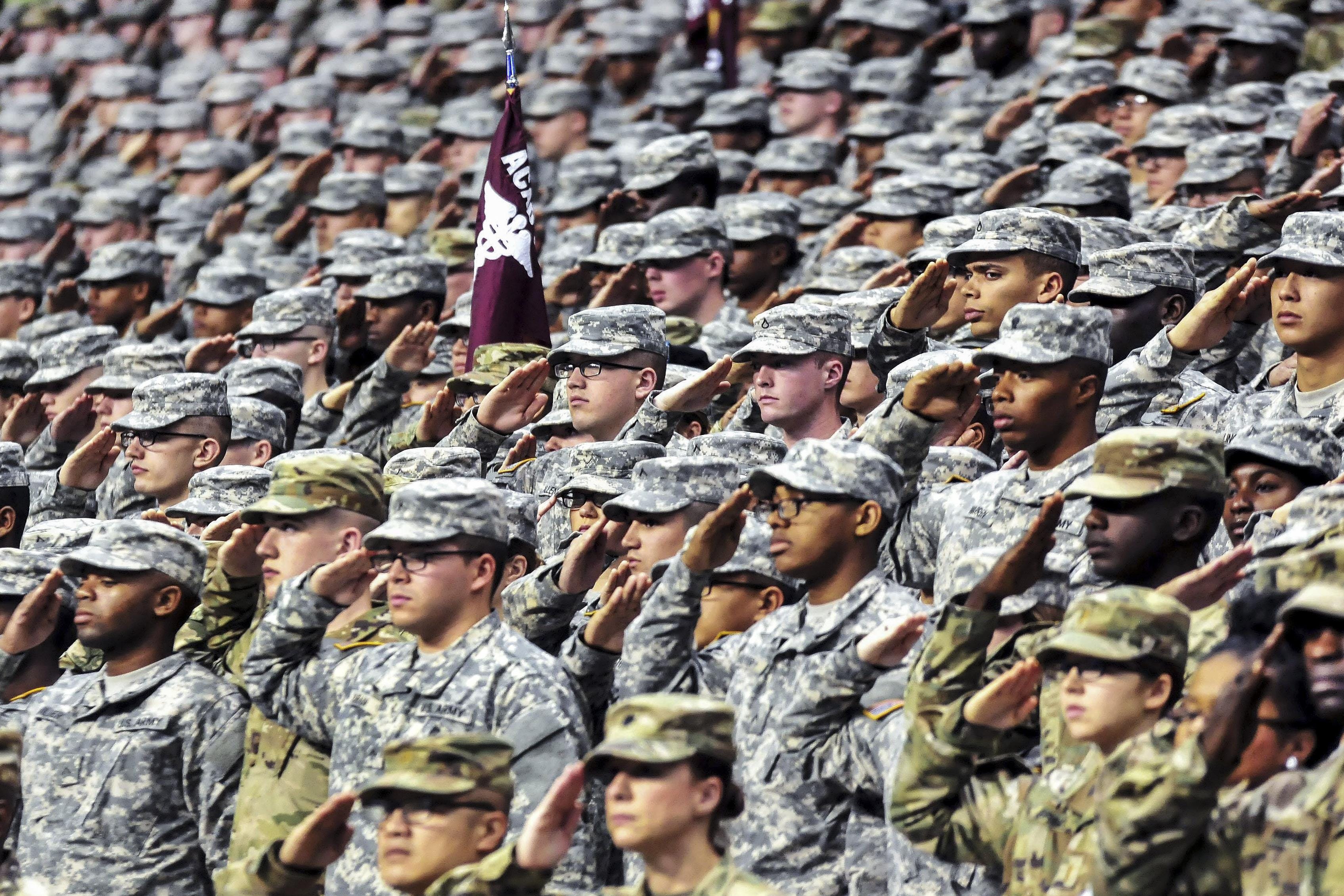
Soldiers salute the colors before the 2016 All-American Bowl in San Antonio, Jan. 9, 2016. The soldiers are assigned to Fort Sam Houston. U.S. Army Photo by Sgt. Bethany L. Huff
The semi centralized process to select sergeants and staff sergeants has lost its way. From its humble beginnings as a quality management tool where the NCO corps would “police itself,” the entire process has turned into sore spot in how we select our most important first line leaders, the team and squad sergeants that run the Army. Somewhere in between the rigid unit-based systems first sergeants and sergeants major gatekeep the selection and appearance to a promotion board, to the other side of the argument where units apply an “olly olly oxen free” approach to promotion. Meanwhile today there are hundreds of joes trying to get promoted. And in the modern habits, everyone has an opinion on the quality of today’s junior noncommissioned officer.
If you know anything about my background you know I more than dabble in the history of the career enlisted soldier, and for the life of me could not describe the genesis for the standardization of NCO promotion boards. In an interview that I conducted with William O. Wooldridge, the first sergeant major of the Army, I attempted to pin down its origins. Some may not be keen on WOW as a point of reference due to later accusations and him becoming an embarrassment to the Army, the fact is he entered the brown shoe army of 1940 and mostly served honorably through the huge post WWII changes to the enlisted ranks and grades. A two-time Silver star recipient Bill was an infantryman through and through and was as opinionated as he was a muddy boots soldier.
Army Promotion Board Tradition
A squad leader at Normandy, Wooldridge came out of the war as a first sergeant E-1 (the ranks were reversed, first graders were at the top), and was an early recipient of both E-8 and E-9 pay, and ultimately the stripes corresponding with the new paygrades that were created in 1958, and after the grades were reversed again. He also served as the senior NCO of the 1st Infantry Division during the division’s initial deployment to Vietnam in 19965 as Sergeant Major to Maj. Gen. Johnathan O. Seaman and was selected as the first sergeant major of the Army in July 1966. His recollection of promotion boards where they were mostly pencil whipped, an informality typically conducted by the first sergeant and names passed to the battalion, but I was left with the underlying sense in hearing his words there was a more formal expectation from the institution.
Since we didn’t yet have the centralized and semi centralized systems at the time of our conversation and he got out before post-war changes were implemented, all boards and promotions during his days were decentralized. In all my research and readings prior to the institution of a formalized set of selection, training, assignment processes that became the Enlisted Personnel Management System of the 1970s, promotions boards, or boards in general, were not institutionalized or have much of a doctrinal reference. They were likely carry-overs from days gone by and were more a tradition than a formal function.
I like tradition. It builds esprit de corps, it connects us to our history and our past, and it’s what makes our institution great. But only when it provides value. I suggest the process for identifying, selecting and promoting soldiers with potential for the next higher ranks of sergeant and staff sergeant needs to modernize, not for the sake of modernization, but to ensure we are selecting qualified soldiers. But the systems keep letting us down. There is a tension between quality versus quantity, along with individual versus organizational expectations. Let me exlplain as there are two sides to the argument that must be presented.
Quality Versus Quantity
It was a eureka moment when I finally realized that when it came to career management, it was Army end-strength that pulled the levers of quality and quantity. Don’t have enough overall soldiers? Then adjust the standards, like reduce ASVAB score minimums for entry, increase retention control points, increase bonuses, etc. Need more 31B sergeants? Then reduce the cut-off scores until you get the number you need. You get the picture if you are in the Army you know the drill. These work great for management, but what happens when the wells run dry? For career management, the quality management systems work great if you can maintain the pool of eligibles, but when the pool empties you have to man those various grade plates, so the first thing to pitch are quality standards, and often time it is the keepers of the standards who get a poke in the eye, and much of the blame.
I have been arguing that the NCO Promotions System is Broke or sergeant and staff sergeant at least since the early aughts, yet the semi centralized method has only endured incremental changes. It needs a holistic review to determine its relevancy as a continued career management tool, as well as determine if there is a more efficient way to provide the quantity of junior NCO that we need that possess the minimum quality standard expected of sergeants and staff sergeants. Maybe there is another way?
Arguing Quality
In this corner, are the keepers of the standards, it’s the platoon sergeants, first sergeants and sergeants major who technically run promotion boards, but it’s the first line leaders who recommend “to the commander” soldiers who have the potential to serve at the next higher grade. If the systems work each company, battery and troop have a home-grown method for recommending that properly begins when a squad leader recommends to a platoon leader, likely through a platoon sergeant or in a platoon meeting, that SPC Dan is ready to become a sergeant. The recommendation goes to the first sergeant in some form or fashion that may include marking forms, reports or printouts that go to the commander, who makes the final decision, which then goes forward to the S-1 and the personalists. So don’t nitpick me here, it’s a general process and may have a few nuances, but in theory it’s how it should come together. It works for the sake of the argument that this is where the first wrinkle comes in.
People are involved in the process, and until AI figures it out for us, people are the weak link in the chain. If all things are equal and the system works, for middle of the road soldiers its usually simple, it’s those on the other side of the spectrum, the duds and the studs, where this gets flaky. A high-speed soldier may get an early nod, a “deep select” in other services, below zone or secondary zone pick for high performers. But that is subjective, as any of those in the chains, the chain of command and the NCO support channel, could derail a recommendation. Or when someone wants to advance a mediocre performer or has failed to identify shortcomings and take formal actions to restrict selection, like counseling, flags, and bars.
People make the recommendations, and the decisions, just for a nomination to make its way to enter the semi centralized selection process, and the system is fraught with problems. 1st squad leader doesn’t want to recommend SPC Snuffy because of some arbitrary standard like he didn’t shoot expert; or platoon sergeant doesn’t select SGT Rodriguez because her ACFT scores are not up to the platoon standards; or first sergeant sure the heck isn’t sending someone up to battalion until they pass a company soldier of the month board. I mean we can always add to the regs, not take away, right? To some, that is how we the NCOs help manage the quality of the corps, right, hold those who want to enter to a high standard?
There goes the NCO corps
And the minute those company level leaders get overridden, “that’s what’s the problem with the Army.” Or NCOs, or whatever. No, that is not being a standards bearer, more the problem, and less the solution. And the solution needs to come from the NCO corps, because we are the ones most affected by it, however, NCOs only recommend, it is commanders who select, as it’s always been. And many rightfully argue, how it should be. Or should it? Next up on my hit parade is the mandatory list integration, and what I warned about, Army Directive 2017-28 stripped away some authority that unit leaders felt in being a part of the checks and balances to maintain a quality NCO Corps.
Let me ask the reader, are sergeants and staff sergeants today better than they were before? Ah, ah, ahh, before you go answering that you better have some context, or at least some better data points than, “well, back in my day……” If your only frame of reference is at your last unit, or this is how we did it in Europe, that dog won’t hunt. Anecdotally we have people on both side of the fence, and in most cases they are going off their gut, not through measurable data points. Most likely, because we don’t use the data we have, but I digress. The party line seems to be that we have the best NCOs ever, yet when hearing for direct level unit leaders’ today’s soldiers and junior NCOs are dorked up. So, who is right here? I am no longer in the operational force today, but I am close enough to taste it, feel it, and understand it from a totally objective viewpoint, and my spidey senses say it’s time to start measuring the quality of NCOs and potential NCOs objectively, and take the human dimension out of it. The old saying goes that statistics lie, and only liars use statistics, but I suggest the data is there to support a decline in NCO quality if you look at the right markers.
Arguing Quantity
While today’s leaders attempt to claw back quality to some arbitrary baseline, the bean counters and generalists continue to wring their hands over end strength at echelon. The factors that affect retention of all grades and cohorts are complicated, and Army leaders surely struggle with dealing with them on a daily basis to maintain some semblance of harmony. And often with struggling systems (I’m looking at you IPPS-A) and outdated personnel systems that cannot keep up with the changing cultures and dynamics. Those like the 50-year-old Enlisted Personnel Management System and its equally ancient NCO Support Channel, which is for another day and another rant. I agree with the sentiment that to retain talented men and women we MUST give them the opportunity to advance, but carte balance integration upon attainment of eligibility is a quantity metric and not one of quality, no matter how you sell it. And if you think every soldier the moment they arrive in the primary zone, if they are well led and trained, are ready to become a U.S. Army noncommissioned officer leader, then you are out of touch with reality about NCOs do, and I am not just talking about sergeants business.
Two Solutions, buckle up
If my prose above got you lathered up then buckle up, here is my bottom line up last, and that is to solve two problems at once:
Annual promotion exams for promotion to sergeant and staff sergeant
Bring back the Technical Sergeant rank
No more promotion boards. All primary zone E-4s must take an annual promotion exam, voluntary for secondary zone E-4s. Promotion exams to grade E-5 evaluate non-MOS leadership competencies in management, decision making, communication, principles of supervision, MDMP, mission command, OPORDs, and problem solving. Make the exam based on the topics in current Basic Leaders Course (BLC) with NCOLCoE as the proponent.
Annual promotion exams
As a multi-tour TRADOCian I can safely say an Army exam cannot be kept up with by the institution, it’s what happened to SQT/SDT. To make this a reality, award a no compete direct award contract to the American Center for Educational Testing (ACET), the same agency who delivers the SAT and GRE. Let them administer promotion exams. Use lowest test score data to determine what subjects to teach at a nextgen future Primary Leadership Course (PLC) to replace the current BLC (which was created without the same type of data and analysis that will now be available), and to be developed, managed, and administered by NCOLCoE.
Once the annual scores are tabulated by ACET, they deliver to the Army a measured ranking of all SPCs in the Army, by MOS. There you go, actionable data, Army. Promote finalists (those above an HRC determined monthly cut line) to corporal after and schedule for PLC. Add PLC graduates to the OML for promotion to E-5. Since STEP is on hold maybe you do both, but optimally STEP is a quality management tool, not quantity. Promote to SGT or Technical Five (T/5) based on inventory, branch, ASI, and future assignment potential. SDAP for all T/5 based on HRC retention objectives.
Advancement exams for E-6 in technical specific tasks as determined by branch proponent for potential squad leaders. Use ACET resources as above. Place graduate on an OML upon graduation and promote to SSG or T/6 based on inventory, branch, ASI, and future assignment potential. ALC for SSG or Rename PME course as the Basic Technical Course (BTC). SDAP for all T/6 based on HRC retention objectives.
Bring Back the Technical Sergeant Rank
I am not sure why people continue to be enamored with the Specialist rank, but every argument about the technical MOSs ends up back there, but without researching and understand the why fors of the failures of the specialists we would only run back to previous failures. There is too much scar tissue in the Army that goes back centuries to specialties and specialists that don’t match today’s opinions and attitudes of rank, responsibility and authority. For sure in this job market our highly technical MOSes struggle to retain people, and part of it goes back to my earlier assertion, not every soldier is cut out to be a sergeant leader. But maybe there is room in the Army of the future for technical sergeants?
The enlisted ranks have not had a sustainable redesign that is not just caving to pressure, since the 1958 Military Pay Bill and the addition of the Super grades. And our history is rife with the missteps, boners and just plain bad decisions that led to a rank mismatch. We had Chief Master Sergeant, Second Sergeants, and Lance Corporals on the drawing board over the years, and what in the end eventually what was approved was a two-tiered sergeant and specialist system. In 1985 we axed the entire specialist program and left the dual ranks of corporal and specialists and got on with our lives. We cut away the programs because the branch proponents said they didn’t have those above E-4 who didn’t supervise somebody. In other words, if you led people, you needed to be a sergeant, a leader. If you want to know who killed the specialist program, there you have it.
For years my position on specialists has been we have been down that road and it caused more problems than it solved, and "real NCOs" (said tongue in cheek) prestige suffered. But because of changing attitudes I have been thinking hard on the topic. I have written enough on NCOs and specialists that I have received some calls and letters the last few years debating the topic with different groups and I have come to the conclusion that if we (the NCO corps) cannot put up a rational and conclusive reason to stay the course with a NCO track only then eventually we are going to be told it's going to happen and to shut up and color. Kind of like what happened with semi-centralized promotions. Naysayers are going to be thought of like the Rangers and the black beret. If saner enlisted voices are not consulted and a reasonable implementation plan not developed, we might hate the outcome of a reimplementation of Specialist ranks even more.
Because of the recruiting and retention crisis the Army needs to do something, so I think everything is on the table. And to make omelets we are going to have to break some eggs, so to speak. I feel the because of the "can do" nature of soldiers, there will be a lot of hand waving over some of the challenges and we will rush to failure. And I may be a victim of it too myself a little. I have been talking about the implementation of EPMS that started in the 60s and concluded in the 80s, the Army can handle the major changes required for a single or dual track specialist/technician system. But the lesson of EPMS is that it took a hell of a long time.
Personally, a deliberate retool of the technical ranks has merit but that would be only to fix the irritants and problems that exist in the current enlisted ranking system and address the unsolved problem of specialty career fields. If we have to go forward finding solutions to past problems of sergeant versus specialist and the burning issues like loss of prestige, who outranks who, perceived preferential treatment, and pay gap, they need academic thought. A reimagined tech sergeant program could be the right direction if we managed the tech sergeant program like we do for SMUs, IMHO. You apply, get accepted and follow that path to retirement. Or you ask to leave (or get asked) and return to the conventional hard stripe world. They have their own track that is unique. But if you return to the conventioal ranks, you have to conform with STEP, PME, and up or out. It’s like an operator going back to their original MOS in the conventional Army.
To reward the technical skills and affect retention, go back to the Vietnam era and take a look at this thing we called Pro Pay. Those who scored the best in a pre SQT-like exam (see promotion-based testing above) received a certain level of pay, like our current SDAP. We could do the same, maybe use industry credentialing to help determine quality and metrics. A certified welder might receive a higher Propay than not, a master welder even more. Pay grades are managed by Congress so policy is going to have to be how we could fund this, and it will need its own line of funding that doesn't now exist.
Bottom line, scrap SPC and create T/4 (E-4), T/5 (E-5), T/6 (E-6), and T/7 (E-7). We already have them at E-8 and E-9, we call them MSG and SGM. Just give the technical ones E-4 to E-9 propay on a scale decided by need kinds of like how we do SRB. How we handle the position some call the sergeant major of the command is for another day, and another rant. Meanwhile, chew on that for a while.
Dan
@topsarge
CSM Daniel K. Elder, USA, Retired