

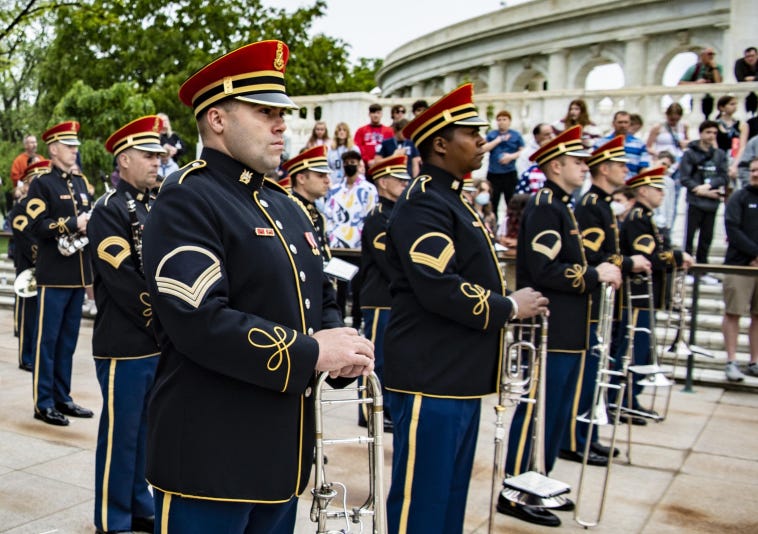
Photograph courtesy U.S. Army from the 2022 Year in Photos collections. This one titled simply, Arlington Honors, and is a cropped versin of the orginal.
"Those who stand for nothing, fall for anything" - Alexander Hamilton
This week after much planning and preparation seven Soldier-for-Life retirees came together and made the decision to step from the shadows and proceed on a plan to help empower our NCO corps in an enduring way. With almost 200 years of combined experience from across the spectrum of the enlister leader continuum, the reputation of this group of volunteers is that we are products of a culture we hope to sustain, all with an eye to the future. Joining us are three early adopters who have accepted fellowships to help us jumpstart this unique effort that has never been tried before; an NCO-focused think tank by NCOs, for NCOs, and run by NCOs. So, what’s the big deal?
Since the days of old, sergeants and corporals were simply first line enlisted leaders akin to blue collar foremen who rose up from ranks and were put in charge of their men with nothing special besides a dollar of pay more and an angled piece of cloth to distinguish them from their men. But NCOs were not given much credit. In the Secretary of War approved 1814 Hand Book for Infantry, William J. Duane wrote “…"the chance of finding non commissioned officers who can clearly comprehend and explain the principles of a good discipline is not one in twenty; from which cause it is twenty to one that the recruits are imperfectly or erroneously taught." It would not be until the final days of the Vietnam war with the scepter of a manning crisis brough about by the ending of the draft that forced the services to improve conditions for the enlisted ranks. And since 1973, minus some tweaks and adjustments, the systems created then around the top three Army grades remain vaguely the same.
Granted, there is no crisis in the ranks today, especially at the squad and platoon level of enlisted leadership, or at least it is not for the sergeant. Company level leadership is pretty much the same as it always has been, and probably how it will always be. It’s really all the other ash and trash NCO positions outside of the clean lines of mission command that are disjointed, and we as a community cannot seem to be able to agree on what right looks like. And the fact that our enlisted leaders end up on the merry-go-round in and out of operational, institutional and broadening assignments that we end up with a corps of generalists. There are exceptions of course, but there are not as many specialists in our ranks as in days gone by. As a result, our systems like personnel management, military education, examinations, evaluations, promotions shift with the winds that the people holding those positions ride in on. It’s exhausting for soldiers today, enlisted and officer.
Let us be clear, our belief is there is a systematic shortcoming, and it is not necessarily the leaders serving now, or in the past. The well thought out NCO structure instituted in the wake of Vietnam was built around the Cold War analog era Army where careerists were the opposite of the more diverse draftee population, and typically were less educated and thought of as more the muscle and less the brains behind an operation. Up to then the best and brightest NCOs were commissioned as Mustangs, or they bootstrapped their way to college and came back as commissioned officers. To be an NCO, high school education was optional and military or civilian education took away from the mission. Not many were able to, or aspired to, higher learning. But that has changed significantly over time, but the major underpinning of enlisted systems hasn’t. We believe that after the multiple Year of the NCO and investments made in leader development it is time to relook the fundamental role of NCOs above the company level, and we suggest more is not necessarily the betteror only outcome.
We don’t seek platitudes, and we realize that sometimes the rotten smell is in our own fridge. Lately, it’s in fashion to call out the role of the senior Army NCO and for good reason. But, for the uninitiated who do not fully understand the nuances of the noncommissioned officer support channel and the fact that the changing authority and responsibilities around their roles is a feature and not a bug contribute to todays culture. This little group working as a not-for-profit effort is not going to change the world and is not meant to. But in reading our Mission, Vision and Goals we hope not to simply stand by and point things out like a credit monitoring service, but to help drive professional dialog, conduct deep research and investigation to the challenges facing noncommissioned officers, and present thought provoking and unbiased solutions.
In the coming months we will be asking the community to help us in our efforts to define the enduring principles of the Army noncommissioned officer, principles that belong to the almost 250-year legacy of the men and women who have worn the rank of corporal and sergeant, and that will last for future generations. Army leaders are merely stewards of the offices they hold now and, in the future, and do not possess ownership. It must be the profession that manages its culture and heritage while holding its constituents accountable. Being a part of a profession doesn’t have an ETS or retirement date but is inside everyone who truly lives up to their commitment. Join us, and let’s get it right.
CSM (Ret.) Daniel K. Elder, Chairman
/toparge
Bernie, thanks for the feedback, and I see your point. When I wrote that phrase, in my mind I was thinking it a witty, tongue in cheek way to decribe those NCOs outside the chain of command structure. In hindsight it may have distracted the reader from the message. Words matter and I will tighten up myshot group and be a bit more literal in writings like this. Thanks for your solid advice.
Thanks for spending time to recognize the NCO and what they bring to the table and how important they are to the military. I am not sure I agree with your ash and trash comment paragraph. Our NCO,s are more educated and have more factors in their leadership than those of past. When they move to broadening assignments they do great NCO work and provide a great example of their ability to change missions and excel. This is a testament to the Corps. When NCO’s leave the military they are now more marketable than senior officers; they hold the same degrees and have more supervisor experience and deal with more complex mission sets than officers (like 20 plus years more). Our NCO’s are only held down by officers who still think they make good bus drivers and don’t want them to excel.