

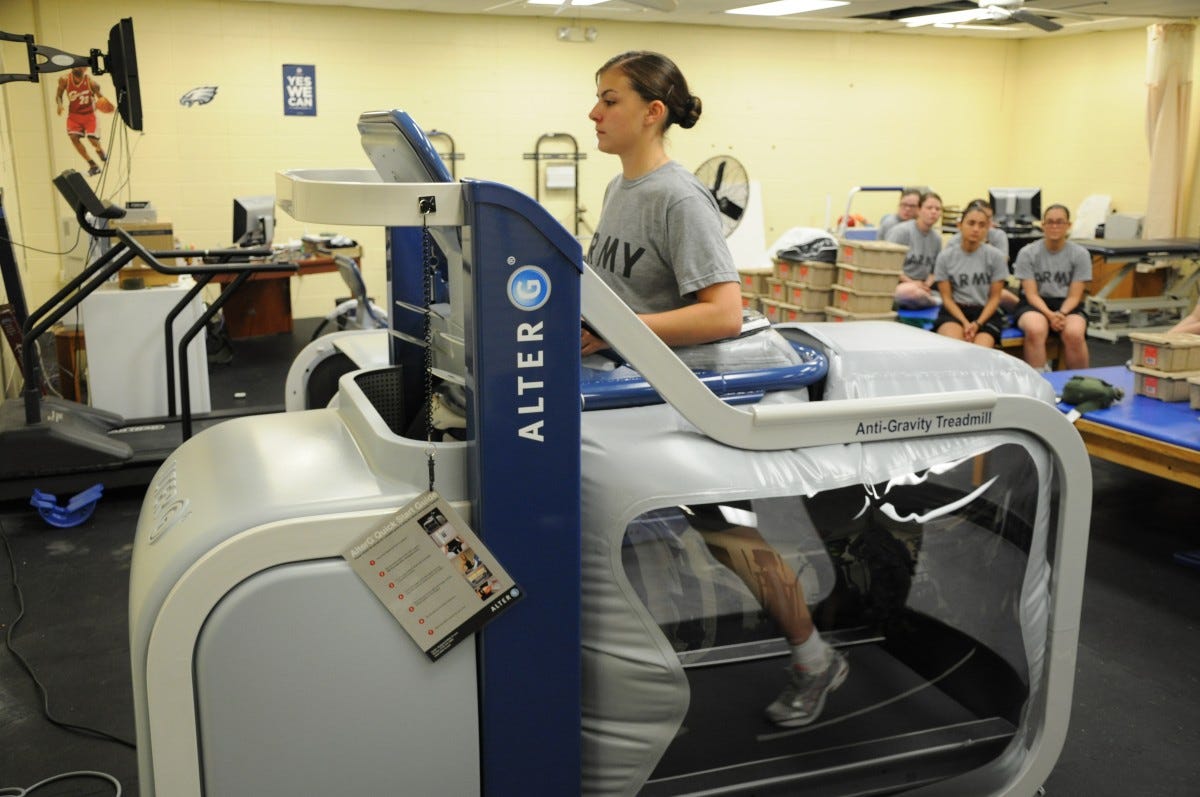
Brigade uses new technology to advance Soldiers' rehab. Photo credit U.S. Army, Susanne Kappler, Fort Jackson Leader, July 8, 2010
With a hat tip to George Jetson in the futuristic cartoon that was his namesake, finally our Sergeant Major of the Army hit the kill switch on an out-of-control treadmill that today's NCOs have been on. Unfortunately, just like the illustrators Hanna & Barbera, the architects of future NCO leader development may have not got all the details of our future precisely right. A result is that the NCO corps of late had been feeling run over, a lot like ol' George.
If you actually thought you would have a flying car by 2020 your expectations may have been a bit too high. So instead, in today’s post I want to look where we actually landed as we give pause and remind ourselves now, we should make time for a revaluation of what the future has become, and to validate Army requirements for NCOs. Let's use the pause to manage expectations on what PME is to be delivered to the NCO by the institutional domain, and when.
And critically, have we come to grips with the answer to the question: is PME to educate Army leaders, to validate operational experience, or by serving as a landing pad for unvalidated “training” requirements and shiny new objects? As we have seen lately, it cannot be all three.
Original Design
As originally designed, professional military education for NCOs was for the first time ever implemented in the wake of the Vietnam war as a three-level system of Basic, Advanced, and then Senior leader institutional training. The courses were touted as sequential and progressive and were intended to be delivered over an NCOs career, culminating at the Senior course. For the first ten years unit leaders determined who was ready for training, at what stage of the individual's development, and which of courses they would attend, and when.
Because of the low turnout at schools, coupled with credible reports of NCOs not being afforded an opportunity to attend these developmental programs, selection was moved away from installation leaders and responsibility assigned to the Military Personnel Center, today's HRC. Sgt Maj of the Army Leon Van Autreve once told a story that when he asked his first sergeant if he could attend an NCO Academy leadership course in the 1950s, he was told "you have been to combat. You know all you need to know."
Resourcing PME for enlisted members and providing them adequate time to attend has been a hot button topic as old as the institution itself. If we are not careful there are many among us who would be perfectly fine returning to those days again. Unfortunately, the programmatics of getting the right institutional training to the right enlisted leader at the right time of their career has again faltered with a much-needed modification to the previous bridging strategy.
In the recent announcement suspending temporary promotions policymakers are reevaluating "the relationship between completion of a formal PME course and promotion eligibility." Before the 1985 decision linking promotions, policymakers had already been tinkering with the number and levels of NCO education. At that time there were five courses: primary, basic, advanced and senior, with a First Sergeants Course as level four after advanced, but before the senior course. Though it later faded away with portions of the curriculum migrating to the installations as a functional course for 1SGs and commanders, but in recent times a Master-level course has filled that gap.
Course, we have Courses
PME requirements since have not stopped at five levels. Originally touted as the capper to NCO education, the senior level, labeled the Sergeants Major Course, has merely become a waypoint for additional courses. Though considered functional duty position courses, the mandatory Command Sergeants Major Designee Courses, one each for battalion and brigade level Cmd. Sgts. Major are delivered to leaders at those echelons in parallel with the Pre-Command courses for battalion and brigade commanders.
Should one be selected to climb the ladder to the stars, a course for nominative-level enlisted leaders is held at the Army War College for executive level finishing. Even still, a joint "Keystone" executive course, originally patterned after the general officer Pinnacle course, is offered to senior enlisted leaders in joint or strategic assignments. These don't include parallel courses for special mission’s unit leaders.
And lastly, an entire series of "tweener" micro credits have been added as distributed leader courses, six of them in total. NCOES, plus DLC, plus functional NCO PME, equals the NCO Professional Development System. Put end-to-end, not including any functional courses for duty positions (airborne, sapper, Ranger, etc.) or broadening (drill instructor, recruiter, etc.). The amount of time NCOs are tied up in institutional career training and development is under the microscope, and camps of thought by those least affected could prevail if not careful.
I fully understand the benefit to our Army and the soldier, of this PME continuum. I am an advocate. It is without a doubt an investment in the NCO corps that I do not take for granted because it is what distinguishes the U.S. Army from all other nations. Before these critical enhancements were developed through much blood, sweat, and tears by officers and NCOs of previous generations who built the infrastructure, early NCO education lacked today’s academic rigor. For 10 years the culminating problem at an NCO Academy was a leaders reaction course on how to successfully lead a team to navigate and assemble a wheeled car and a barrel over and through an obstacle.
Keeping Education in NCO PME
Today enlisted leader training follows a standardized rubric that has been matured at modern institutions of higher learning. In many cases the detail of instruction, by grade and position, is academically comparable to colleges and universities across the nation. Combined, now this continuum of learning not only results in a DA Form 87 Certificate of Training, but often baccalaureate level credits, or even feed into a college degree.
As good as the news was, last week there was a crack in the mortar that has attempted to hold all of these advances together. And that was the decision to suspend temporary promotions and reduce the crippling pressure on the force to get NCOs to school in order to meet Select, Train, Educate, and Promote goals that sprang from NCO 2020 STEP initiatives.
From my unique vantage point, I am not sure in looking end to end if what we have today has it right, and I have come to ask myself maybe we have gone too far in requirements for NCO PME? Five levels, 3 functional courses and 6 DLCs (that apparently are in some sort of quasi limbo). All tied to promotions, albeit with the recent safety valve release in the SMA Sends message shifting course requirements 1 grade later in a career. If you know the answer, ask yourself if the enlisted leader cohort is the only one with such academic rigor required in our mandatory career professional development, and if so, then why?
One plausible reason the SMA had to call a "cease fire" may be a case of a self-inflicted casualty; an over investment in the wrong areas of leader development, PME for the sake of it, instead of need. Going into Operation Desert Storm many said the Army NCO was the best trained, best led, and most educated. Some would say the same for the Global War on Terror. Likely, but also true, is that the NCO of today is equally capable. As a student of NCO history, it is my belief that today's overburdened NCO is capable of STEP but cannot keep up with all the demands being placed on them from the three leader development domains, so something has got to give.
During this pause a fundamental question must be debated and that is to refine what competencies the Army requires of NCOs at each echelon and grade, and then develop to those requirements. PME is being constructed around the NCO Common Core Competencies, yet policymakers have drawn out a 4x6 NCO development model, along with the Leader Requirements Model, in a one size fits all approach without fidelity across echelons. The generic LRM does not consider the lack of authority afforded to the NCO Support Channel by Army Command Policy, which causes friction when NCOs take action. Developing a competency is wasteful if it is not to be used, and authority for action is dependent on commander, location, higher commanders’ intent, and local policy.
Redefining Requirements, not $$$
Select, train, promote and educate has merit, but tempo has not allowed the Army to implement it, and at current pace, was spiraling. Maybe instead of attempting to wrap STEP around the NCO Corps, instead we dial it, and NCOPDS, back a bit. While Tempo is high let's trust the T part of STEP, and rely less on the E. To do that requires trust, and that is trust that the policymakers will not ravage PME funding, never to return again. Investments made in the institutions must remain and be temporarily remissioned, not unfunded and dismantled.
My belief is that senior NCOs will come together like the commanding generals of TRADOC and FORSCOM did last week. I recall during my time in service there was much hand wringing by Luddites who instead of transformative thought demanded "just in case" training in PME. In our basic PME course, then known as Warrior Leaders Course and others, we were devoting an inordinate amount of our professional military education academic hours on skill level one training, or in validating unit responsibilities. My buddy and fellow PME curriculum developer at USASMA SGM Felix Sanchez would rhetorically ask, “we spend so much time getting back to the basics, when the hell do we make time for the advanced [stuff]?”
You see, back in the good old days we would conduct fitness tests, weapons marksmanship, and evaluate dismounted land navigation skills using a lensatic compass, a map and a protractor because during Airland Battle our adversaries would surely deny our use of air space based advanced technologies. Meanwhile, while those debates went on, we had already fielded portable satellites, gps systems, blue force trackers, we had command and control systems on the move, WIN-T, jammers, and mobile subscriber networks, among other things. We didn’t offer training of any sort on skills using those items that NCOs were sure to come in contact with. So, the arguments were always exhausting, and many of those voices seemed to carry the day.
But today's Army is so much smarter, and our tech and our advancements much farther along, notwithstanding observations of future large-scale contingencies seen during actions in Ukraine and Gaza. I am sure glad those Luddites are gone and that we have moved on to bigger challenges in our PME. I think we are finally ready to meet George Jetson.
Dan
CSM Dan Elder, USA, Retired
@dandotelder
CSM, Great evaluation of NCOES. DLC should have only been a stop gap to help fill the void for those needing PME but were not able to attend because of deployment requirements. Distance learning may have a place in the future of NCO PME, but not as stand-alone courses. You cannot learn to lead others by making posts on Black Board! With all the schooling NCOs need now, there is no time for them to engage in the other two pillars of professional development, operational assignments, and self-development, you know reading stuff because you want to, and participating in professional associations.
S
CSM (R) Chris St. Cyr