

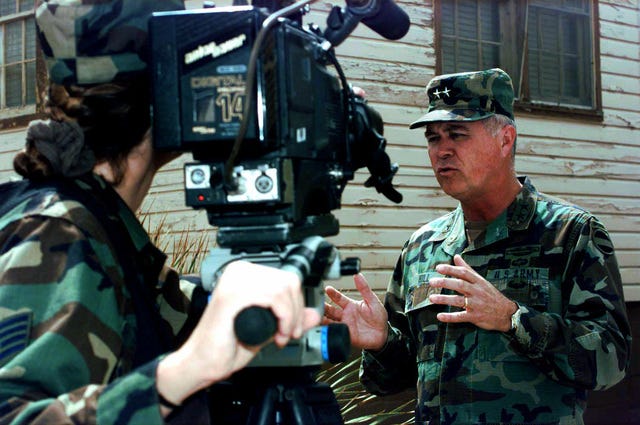
(26/04/1997) Major General James T. Hill, Deputy CHIEF of STAFF of the United States Army Forces Command, and Roving Sands '97 Exercise Commander Forward, speaks on the accomplishments of the troops involved in ROVING SANDS 97 during an interview with the 1ST Combat Camera Squadron. -A1C Benjamin M. Andera, USAF
I have held on to this typed speech from General James T. Hill for who knows how long. Unfortunately I did not cite my find, unaware of still today on how I came across what appears to be an orginal copy, likely collected from an archive or another dusty folder in my hunt for real-world examples of leadership in action. I typically write about enlisted leaders and noncommissioned officers, but today on this particular birthday of America I wanted to share words of experience and wisdom for those in uniform who might be asking themselves “what’s it all worth.”
I never served directly with Gen. Hill, but we served in the same Army during the last 20-years of his career. According to History.net he “retired in 2004 after serving as commander of the U.S. Southern Command from 2002 to 2004. He is credited as being one of the architects of rebuilding the Army in the wake of Vietnam. In February 1991, General Hill served as brigade commander in the 101st Airborne Division, when he played a key role in Operation Desert Storm and winning the Gulf War.” Seeming to me as a speech to a group of familes of the 25th Infantry Division, which he commanded from June 1995 to June 1997, making this topic something apparantly top of mind to him almost 30 years ago.
These are his words, and for many long forgotten, but hopefully his spirit of hope and pride rings true still today. Happy Birthday America.
/topsarge
Graduating from high school in 1964 -fully one year before the first major battle of the Vietnam War, the first battle for the Ia Drang Valley, described in LTG Hal Moore and Joe Galloway ' s brilliant book, We Were Soldiers Once and Young -I had appointments to the Naval and Air Force Academies, but at the last minute decided that I didn't want anything to do with military life. So off I went to Trinity University in San Antonio, sight unseen, where much to my surprise there was mandatory Army ROTC.
Vietnam looming on the horizon, I stayed in after two years, went to ROTC summer camp, and found I kind of liked the camaraderie, the challenge . I chose Infantry on commissioning in 1968, thinking that I liked what I thought was the Army and might even make it a career, but if I was going off to war, I might as well find out what real war was about and go as an infantryman. And, I confess, I was 21, and like many youths, a naive idealist, a romantic . I believed there was glory in war, a chance to test my courage. I know now that there is no glory in war, in its suffering and agony and tragedy, but there can be honor in war, Honor found in the soldier's creed of selfless service, service to a people and a group of soldiers and a country and an army and an imperfect process called democracy. I joined and served a draftee army in Vietnam -a very good army. I was a rifle platoon leader, a recon platoon leader, and a company commander in combat honored to lead American soldiers in combat.
To this very day I hold that service, command of an infantry rifle company in combat, as my greatest privilege -my Combat Infantryman's Badge, my highest award . I served in a disciplined force, saw nothing of the horror stories of indiscipline shown in movies like "Platoon". I did not serve in Oliver Stone's Vietnam . I remember young men of courage, good humored, and goodnatured, under some terrible and frightening conditions, longing to return to the "world" as we called it. And we all did r e turn, some on freedom birds to an uncaring, unsympathetic society, and some in body bags, to grieving families, alone in their sorrow because we didn't go as units, and therefore family support groups -God bless family support groups -weren't there to help. Another word on family support groups. I'm going to read a segment from the epilogue of We Were Soldiers Once and Young. The words are Betty Mapson's whose father died in the Ia Drang Valley. If after hearing it you still don't understand the absolute necessity for family support groups and pledge yourself to be more helpful to families -that is the calling I spoke of earlier -then I say you just don't get it and probably won't. So, at the end of your tour of duty, go on back home, let someone more caring take your place. We lead and serve people, not personnel.
QUOTE
After the initial shock of receiving the telegram announcing daddy's death, we kids had to go back to school because it would be two weeks or more before his body would arrive home. It seemed everyone was looking at us and whispering, not really knowing what to say except how bad it was our daddy died over there. They mostly left us alone. There were no support groups or any of that to help us cope. Our family was left alone in our grief. My brothers did not talk about their feelings at all. My mother was devastated. She and daddy were sweethearts in school but each went on to marry other people. When both were divorced around the same time they met again and were married. Daddy and I used to take trips together on the greyhound bus, mostly home to Savannah. Whenever he and my mother went out, he would not be ready until he sat in a chair and had me comb and brush his hair. It was cut real close but he made it seem like I had really done something special.
I remember when he first told us he had to go to Vietnam. We drove him to Fort Benning. I remember the army trucks filled with soldiers and hearing daddy say he might not come back. I was young and didn't really see the seriousness of it. He was a good, strict father and my brothers and I thought his being away for so long meant we would be able to stay out later and have more fun. I blamed myself for daddy being killed because of those selfish feelings when he left. My daddy was a good man, a preacher's son. His given name is Jeremiah.
Two weeks after the initial telegram, we got another one stating when to meet the body at the train station . The hearse was already there when we got to the station and soon a wooden cart with a long gray box was being pulled toward us. My daddy! This is how he came back to us. And the pain started all over again for us, only more so because now he was home. You could have heard me screaming three states away. At the funeral home remember looking at him closely and for a long time to make sure it was really him . Then I saw that little mole on his cheek --and I knew.
I am so proud of my father and wished that somehow he could know that and know that he is still very much alive with us. For a long time it seemed to me that he was just away like he usually was on Army duty, and one day he would come home. For a lot of years I waited and watched our driveway because I wanted so much for him to come home for my momma and my brothers and me. I would like to visit the Ia Drang. It is something I have to do for my own sake. I have to know, have to see that this place really exists. I need to see and to be where my daddy died. Then maybe this will all somehow be complete for me. I just wish with all my heart that we had not been so alone to deal with such a monumental tragedy back then. We needed someone to reach out to us, to explain for us, to help us see why. My mother has passed away now. She never remarried. She loved daddy so.
UNQUOTE
There is a plaque on the right wall, just as you enter the Tropic Lightning Soldier's Chapel. It is dedicated to the dead of Vietnam, but I believe also dedicated to the survivors. It reads, "not for fame or reward, not goaded by ambition or lured by necessity, but in simple obedience to discipline as they understood it, these men dared all, suffered, and died .
"You ask why I serve -why, indeed! I found out something about myself in the jungles of Vietnam. I loved the Infantry and the Army ... and I was pretty good at it. I stayed, applied for and received a regular army commission. But, the army that emerged from the jungles of Vietnam was a shell of its former self, the old NCO corps -the sergeants of World War II and Korea that led the Army into Vietnam -had either retired or been killed. The American people, through their congress, decided we needed a volunteer army, not an army of conscripts, and ended the draft.
We entered into a new age -and the birth pains were agonizing. It was the 70s, the period I call the "Awful Army" .. . where in the 25th Infantry Division of the mid-seventies you could not go to the field without losing one or two weapons . .. when, as a company commander, if you only had 5-6 AWOLs a week in your company, you were a great leader and people asked you how you did it .. . where sergeants feared to go into the barracks when they were charge of quarters, and staff duty officers wore side arms. And I do not exaggerate to make a point. It was that way, and not only in Hawaii, but throughout the Army. There were three involuntary officer reductions-in-force in the seventies: the first got bums, the second and third took good officers, and other good officers were bailing out right and left. As a young captain, I signed my resignation papers twice, but just could not go through with it. I told my wife, Toni, that I simply could not walk away and leave it -my Army, my soldiers -in the hands of others. Who will lead, I asked her?
Who will lead? Why I serve? Why, indeed. Well, we survived the 70s and began to thrive in the 80s. We hit rock bottom as an army, and maybe as a nation, in the desert of Iran as we failed ignominiously trying to rescue our 53 hostages in the embassy in Tehran. We weren't trained, and we weren't ready, and as a result, we failed the Nation. It's so vivid to me, the sixties and the seventies, just like it all happened yesterday, yet I know that it is alien to all of you here -and throughout the 25th Infantry Division, that is true.
Neither of my assistant division commanders served in Vietnam, and of all my brigade level, 0-6 commanders and staff, only the Chief of Staff, served in Vietnam. Very few of our CSMs served in Vietnam, only two leap to mind. And while the colonels know the 70s, even most of my battalion commanders, entered the Army in 1980 and afterwards. So, how did we survive the 70s to thrive in the 80s? I believe it's because we shared a common set of values: honor, duty, courage, loyalty, integrity, respect, and selfless service . Even in the darkest hour, when it appeared that the inmates were running the asylum, the leadership, steeled in the jungles of Vietnam, didn't quit on the American dream, though for a time we thought the American ideal had quit on us. We stayed the course, believed in ourselves and in our values -duty,
honor courage, loyalty, integrity, respect, and most importantly, selfless service -and we did not lower ourselves to the lesser standard. We were guided by the visionaries of the day -Chiefs of Staff of the Army like General Shy Meyer who had the guts to call it "hollow" like it was then, but not today, and General John Wickham who almost single handedly reminded us that we had to respect each other, to be our brother's and sister's keeper, to make a difference in the lives of soldiers and their families, and thereby readiness. They gave us the tools to reclaim the Army; urinalysis, higher recruiting standards -high school graduates became the norm not the exception -the CTCs, a new training management system and ethos, and "Be all you can be." None of you will remember the original recruiting slogan of the volunteer army -"the U.S. Army wants to join you" -join you? No way I want to join you; I want you to join us -be all you can be, a challenge to leader and led alike.
So, for the most part, it was my generation who rebuilt the "Awful Army," rebuilt it with discipline and hard work and Ronald Reagan dollars and vision, rebuilt it into a trained and ready force, the best army the world has ever seen, took it to the desert and proved it to be so. It wasn't easy -it took sacrifice and courage and hard work by some of the very best men and women in this nation -but it was worth it. Today, the American people respect, not revile you; you are a revered group of professionals -as it should be and will be, or I'm out of here. I will not go back. You ask why I serve? Why, indeed.
We have endured as an army of professionals because we were, are, and will remain a values-based army, an army made up of folks who live and understand the values of honor, duty, courage, loyalty, integrity, respect -and, mostly, selfless service. We all come at selfless service from different perspectives, but we all come to it knowing that we serve a greater good, a greater cause and we do it as I said earlier, not for fame or reward, not goaded by ambition or lured by necessity. And, so it must always be.
We won the cold war, yet there is no peace. There are still forces, evil forces, at work in the world today that would take away our freedom, destroy our way of living. We must, you and I, continue to stand in the breach, to serve, to protect and defend our country and our people. And it requires the best men and women among us, men and women dedicated to selfless service, bolstered by duty, honor, courage, loyalty, integrity, and respect. Those values got us through the 70s, and they will guide us as we continue to be a trained and ready Army, as we overcome the troubles of today just as we did in the past. Why I serve? Why, indeed.
I am reminded at gatherings with young professionals like you, like this. I am reminded every day. I am reminded every time I run with soldiers and hear their cadence and the sound of their feet striking the pavement. I am reminded every time I hear of a family support group picking up the pieces after tragedy strikes in a unit. I'm reminded every time I see Army family volunteers giving freely of themselves for the greater good of the community. I'm reminded every time I hear Reveille, To the Colors, and Retreat, and especially Taps at night. I am reminded every time I look into the face of my son who is the future of this magnificent country. And, yes, I'm reminded by the faces and voices of the past, who call out to me at odd times -faces and voices with names unfortunately long forgotten, I'm embarrassed to confess; soldiers who asked for little except to be well led, treated with dignity and respect -and honored.
It seems to me that sometimes I can feel and touch their spirits as if they were still here, soldiers forever young . For as the poem goes, "they shall not grow old as you and I are left to grow old, age shall not weary them nor the years condemn." I deeply believe that you and I, the very best men and women our nation can produce, serve in a noble, honorable profession -the profession of arms . And, I don't know about you but, as for me, when this life ends, as it certainly will, I will be content if my tombstone reads: "He served . He was there." You ask why I serve? Why, indeed.
God bless you. God bless our great Army and Nation.
-Gen. James T. Hill