

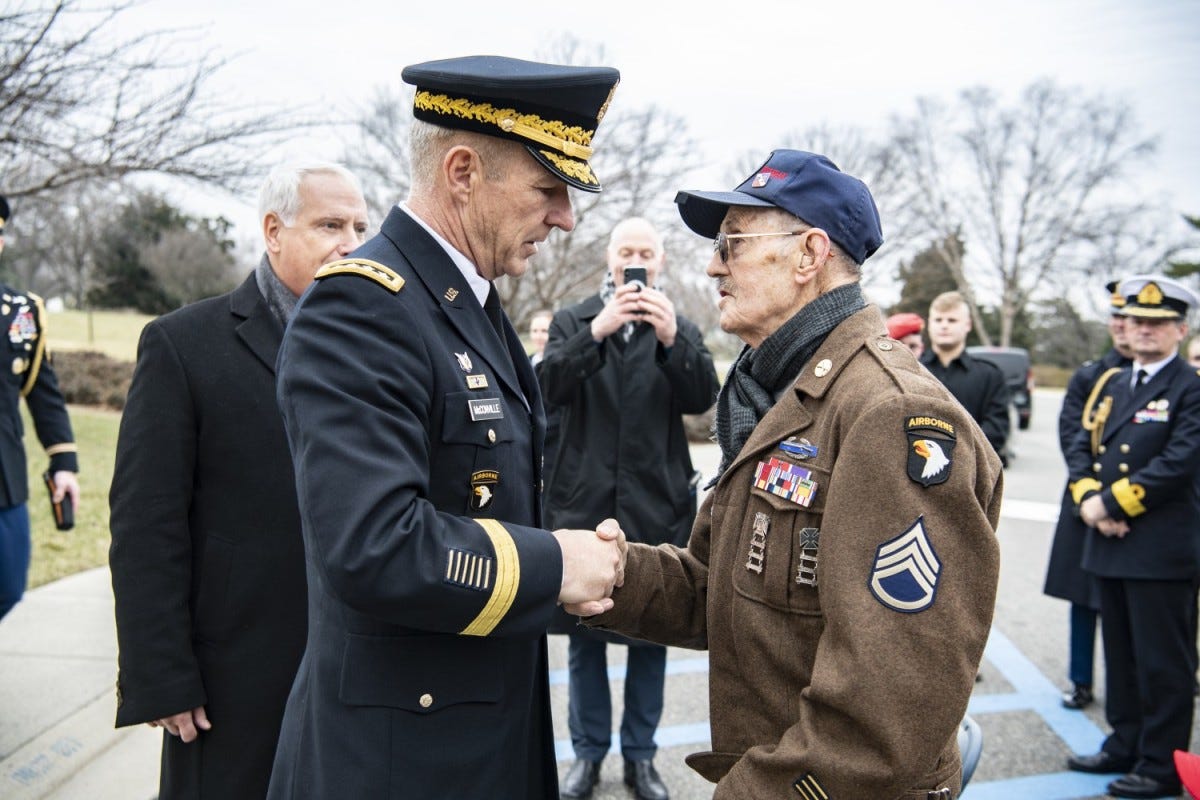
Chief of Staff of the Army Gen. James McConville (left) speaks with Darrell Bush (right), 98, a former U.S. Army Staff Sergeant and a WWII veteran of the Battle of the Bulge, at Arlington National Cemetery, Arlington, Virginia, Jan. 25, 2023. Bush was at ANC to view a wreath-laying ceremony at the Battle of the Bulge monument, commemorating the ending of the Battle of the Bulge on this date in 1945. (U.S. Army photo by Elizabeth Fraser)
I honored Dr. Martin Luther King’s legacy this past Monday by poking my head back into history books and reconnecting with our past. Of late my interest is in post-Civil War reconstruction and how the U.S. Army was employed in the south, especially in my new home state of Texas. It showed me some parallels to my other interests, the Army noncom. So let me preface with a trigger warning because though I would not attempt to align the plight of civil rights with the struggles of the career enlisted force, both for much of our nation’s history remained in the shadows of others.
Just like my research and investigations into the development of new initiatives for NCO leader development, I have been looking at sources to describe the employment of the U.S. Army organizations in the 1860s and 1870s within my county. I have been trying to learn how the establishment of the War Department’s Freedmen's Bureau fared locally. And, to understand some of the actions taken by the people involved, and how the locals received it. Well, it is Texas after all, so just take a look at that history then and since, and you can conjure up thoughts about how you might think my research has come out. But one thing is for sure, it is hard to pin down influential people beyond the traditional majority of local influencers. In other words, besides some “Miss Mabel” this, and “N-word Joe” that, there is not much identity to the mostly African American minority in the region in written records. And that is where the sliver I speak of, intersects. Until modern times, and short of exemplary honor on the battlefield, NCOs have been nonentities in the annals of modern military history. Not to the horrible level of enslaving humans as laborers or possessions, but in a metaphysical way.
I was proud to note that it was a Corporal named John Bruce of the 6th U.S. Cavalry who led 4 other men to help keep the peace here in my county until about 170 men of A company of the the 17th U.S. Infantry arrived a year later. I found from a monograph on the 6th Cavalry a caution that “the records for this period are very unsatisfactory, and important actions, in the light of to-day, are entirely omitted and remain only as traditions from the generation of war service men, who have almost entirely passed away from the regiment.” Men like CPL Young are hardly a blip on the expanse of time that our union has existed, but surely among the pages of our Army’s history there have been significant contributions of enlisted men and women of note, and worthy of ink? Today’s food for thought centers around the training revolution that occurred from 1973 to 1990 and was clearly a period of significance to the noncommissioned officer, but apparently only known to those from within the system they helped create.
A lead into my point is that its high time NCOs get more in the habit of writing, punctuation mark. African Americans of the post-civil war era were excluded from education in the south, slaves didn’t generally have the benefit of knowing how to read or write. And, if you want to be honest about the noncom of the past, besides the world wars, meaning periods of mass conscription and the draft, there is a good chance sergeant up to WWII might not have been much better at reading and writing. Oftentimes it’s been said, the best fighter, or the scrappiest soldiers were the ones who got the stripes, and the respect of the men they had to lead. Thinking of the draft that ended in 1973 and the caliber of the WWII era senior enlisted soldiers filling out the ranks of the 1970s and into the 1980s, it becomes a stretch to not find a few enlisted influencers during the most significant period in NCO leader development. Its wasnt because people were not writing about NCOs, but NCOs the people around them were not writing about the activities, setbacks, accomplishments, or involvement of the enlisted leader. I find that curious still today.
While doing some research for my latest book I came across the TRADOC Historical Study Series and the book The Army's Training Revolution 1973-1990 by Dr. Anne W. Chapman and I was gobsmacked by the fact that she mentioned by name every Commanding General, Deputy Commanding General for Training, and Deputy Chief of Staff for Training who rightly so were credited with played a role, whether starring or supporting cast, responsible for that revolution. What surprised me was that not one sergeant was named. Okay, I get it, it is about a 48-page monograph hitting the wavetops of some of the major initiatives that happened across the institution and there was not room for every contributor. I mean there were not council of colonels or iron major’s mentioned either. If it were almost any multi decade review of the entire US Army I would shake my head and move on, but I had to tap the brakes in considering that 1973 to 1990 were probably the most significant “revolutionary” period in the entire history of the noncommissioned officer corp, before and since!
In my return to writing blogs again just recently I talked about the 50-years of EPMS and the significant actions that took place during that era, most importantly was the creation of the first bit of centralized PME in the name of the NCO Education System (NCOES), and of course I give honor to the thought leaders like Depuy, Starry, Vuono and Thurman who were at the top of the list of revolutionaries that Dr. Chapman tributed, and what I wholeheartedly agree with the significance. My thoughts went to why, what was it that led to the omission of the “invisible hand” that helped drive the unique changes happening within the enlisted ranks at the same time. Though it was a TRADOC piece, and it makes sense to have a generic approach to institutional training. But the word sergeant is mentioned once. That singular reference was to mention the position of sergeant major of the Army, however not any one in particular by name. The author was not a soldier, or at least I did not see a reference to service in her brief bio. She may have not had much association with, or been exposed to, noncommissioned officer influencers. However, what I think makes more sense is that the author looked to written histories, books, interviews, and public writings on the organizations and the people named either as subjects or authors, and contributors.
Having gone through many books, periodicals, magazines, archives and the like it is few and far between an NCO who has written and been published with any frequency throughout time. It the absence of enlisted input to the narratives of our current and the “first drafts” of history, it becomes left to historians to tell the stories of bygone days. They are the ones to chronicle those who left and impact along the way. Who are the historians and novelists of the professional enlisted soldier today? E. L. Doctorow said, “the historian will tell you what happened, the novelist will tell you what it felt like,” and I submit to you that those living the now are the novelists that shape the histories of the future. The Modern War Institute’s Harding Project is taking a run at this gap by using the experience gained from the staff and volunteers from their other initiaives, and I have been pleasantly surprised to see responses from NCOs who have thoughts, ideas, TTPs and other points of value to contribute.
Initiaives like Harding is what I hope will be a start of a new rise in enlisted men and women from all components coming to the forefront to tell their and their team’s stories, and to put down for posterity the contrbuitions of the total team. The Harding Project is taking a run at this gap by using the experience gained from the staff and volunteers from their other initiatives, and I have been equally surprised to see the results. So what are you waiting for, its time to get out and write something, sergeant!