

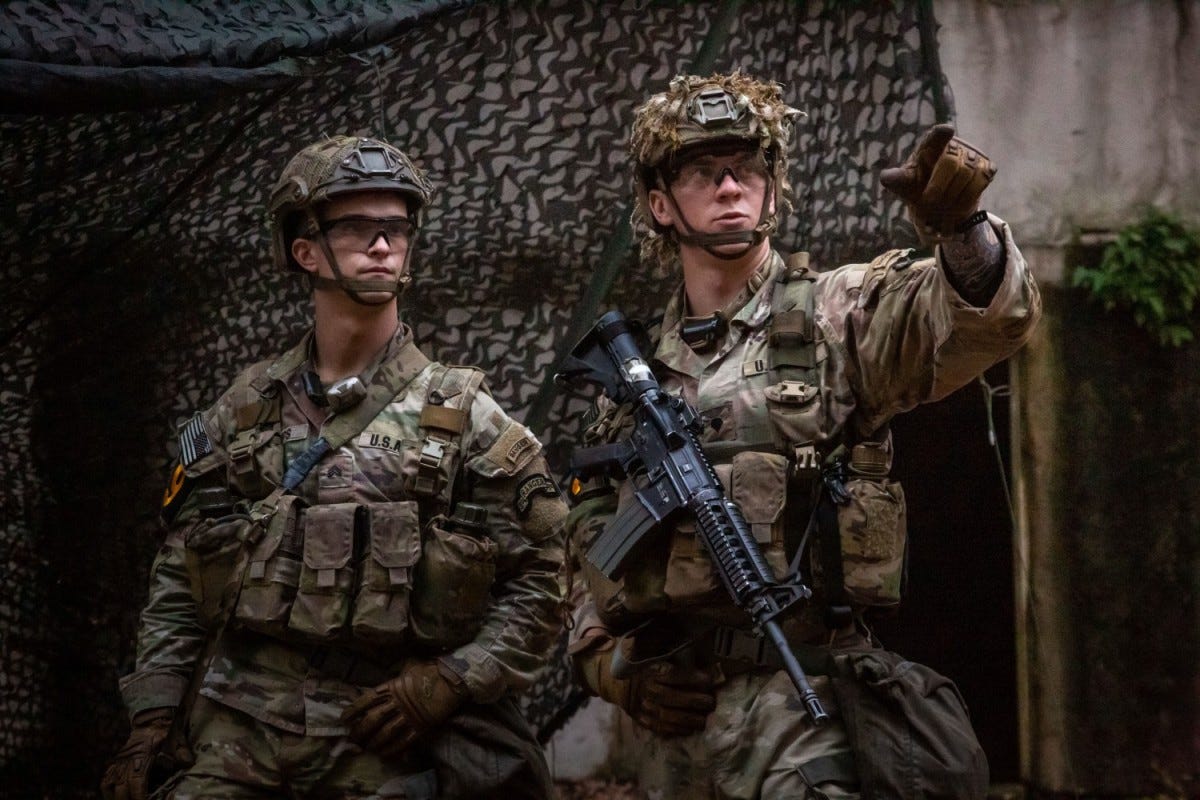
Sgt. Jake Phillips, a native of West Chester, Pennsylvania, and Spc. Chancellor McGuire, a native Georgetown, Texas, representing the U.S. Army Special Operations Command, prepare to evacuate a casualty during the 2023 Army Best Squad Competition at Fort Stewart, Georgia, Sept. 28, 2023. (U.S. Army photo by Spc. Theron Smith)
Revolutionary Sergeants
At the start of the American Revolution in 1775 the Continentals did not have an Army and instead relied on militia of part-time citizen soldiers from the original 13 colonies. Formed similar to European armies, “private soldiers” were grouped into teams called “squads.” From within those groups, selected men were designated by the commanding officer as the leader among them and called them sergeants. These “noncommissioned” officers were foreman-like, akin to first-line supervisors who assisted their officers by directing the work of the “privates” and helped keep their group on task.
Assisting the sergeant was a subordinate leader known as corporal; together, they oversaw more than a dozen privates in squads which served as the nucleus of the Army’s most basic structure and that still today is the foundation of an organized military unit. Appointment to the position of sergeant, or the lesser authority position of corporal, had always been a rite of passage bestowed only upon the most capable soldiers from within the ranks.
Sergeants of that era were used as file closers—in battle and posted at the rear of a line of privates’ shoulder to shoulder or on the flank (side) of a column of soldiers one behind the other. File closers made on-the-spot corrections and ensured the rank and file held steady and followed the commands. In the first recognized instruction for the order and discipline of the United States Army, a handbook (the Blue Book, named for the color of its bindings) was penned by former Prussian soldier Friedrich Wilhelm von Steuben.
In his Instructions for the Sergeants And Corporals von Steuben noted that “Each sergeant and corporal will be in a particular manner answerable for the squad committed to his care. He must pay particular attention to their conduct in every respect; that they keep themselves and their arms always clean; that they have their effects always ready, and put where they can get them immediately, even in the dark, without confusion; and on every fine day he must oblige them to air their effects.” There were about ten tasks in that section of the blue book that he attributed to the responsibilities for NCOs directly, though he makes mention of sergeants and corporals throughout. That “regulation” was referred to for many years, and I recall reading some passages where it was used by some into the mid 1850s.
The Very Model of a Modern Sergeant Major
Today’s NCOs still have their basic responsibility for the welfare of their soldiers and the accomplishment of their mission. For most people’s understanding, that responsibility can be pinned to squad and team leaders from corporal to staff sergeant. There may be some section sergeants or vehicle commanders that also have a clear cut role and responsibility known by all, but beyond the squad formation the roles and responsibilities of the remaining sergeants gets a bit dynamic. The platoon sergeant serves an instrumental role in the development of their platoon leader boss, but must be ready to step in and perform those functions should the paltoon leader not be available. The first sergeant serves as the top kick for the company and has a training and administrative role that has endured since von Steuben.
Minus a few exceptions, the squad leader remains the only enlisted leader in the true chain of command, the remaining NCOs operate within a parallel communication chain called the “NCO support channel,” (NCOSC) first codified in the 1978 Change 8 of AR 600-20, Army Command Policy. Paragraph 2.2, noted the Staff or technical and noncommissioned officer channels “supplements the chain of command and is used to accomplish routine, but important tasks and responsibilities.” The 1986 version of the regulation added a section 2-3 and identified the noncommissioned officer (NCO) support channel separately from the staff/technical channel and designated it as a stand-alone paragraph. In it, the regulation listed the 11 important tasks the channel was responsible for supporting chain of command in, reminscent of von Steubens regulations and NCO task listings. Besides the squad and team leader, I wonder if its time to refresh roles and responsibilities of the remaining NCOs in the NCO support channel?
Reframing the Roles of the NCOSC
Since the creation of a large(r) standing Army and the addition of the supergrades (E-8 and E-9) in 1958, there continues to this day a bewilderment of the role of NCOs above the company level who are serving anywhere other than an obvious broadening assignment (recruiter, OC/T, drill sergeant, etc.). Sergeants at brigade, division, and echelons above reality in places that traditionally were the domain of commissioned officers can sometimes throw muddy boots field soldiers for a loop. Add in other than high density locations like instructor duty, working with civilians and contractors where rank and status don’t carry the same weight as when an NCO deals with a soldier, a whole other type of friction occurs. I feel over the years I have heard it asked more times than I can count what good are NCOs above the company level?
Those who have heard me on my soapbox know I am of the opinion the NCO Support Channel as written needs a refresh. Too much change has happened with, to, and from the NCO corps since its inception. It is high time we relook the basic framework of paragraph 2-19, and even quite possibly the eleven functions that the NCO support channel that NCOs are directed to assist the chain of command within accomplishing. One of the major shortcomings is the ever-changing authority, or the length of the leash, afforded the NCOSC. As prescribed, commanders define the responsibilities and authority of their NCOs to their staff and subordinates. The problems come when those at subordinate levels don’t get the message and see what they believe to be NCOs operating outside their lines of authority. They didn’t get the memo and that often causes friction. It’s even worse when the NCOs are two or more levels above their position.
More NCO Authority
It’s high time we “pin the rose” on NCOs and grant additional organizational wide authorities based on duties and assignment. I do not profess to have all the answers in a short blog post, but these ever-changing lines of authority coming from commanders’ intent, NCO Charters, rules of the road and left and right limits when not spoke of often is confusing to leaders at subordinate commands. When created in the 1970s the NCOSC was a talent management tool created to provide responsibility and authority on the NCO Corps, but it was created around a different talent pool. The all-volunteer Army was still in its infancy, barely 5 years old and surrounded by a brand-new enlisted personnel management initiative. Much NCO talent was being underutilized. It was based on the informal “sergeants major network created in the 1960s. As early as then the support channel has been looked at suspiciously or with derision. In 1966 at an AUSA conference Army Chief of Staff, General Harold Johnson told the Army’s senior sergeants, “you have to be careful now that in this sergeants major chain you are not establishing some kind of end run position, because this, if it ever developed, and if it ever were then ever identified, would be the very quickest way to torpedo the whole program.” NCOs exerting authority continues to be looked at suspiciously.
The NCO Corps has changed, we can be trusted with more authority, and for the organization to institutionalize it. The amount of development, from BLC to MLC, the SGM-A, CSMCs, NLC and more, the accredited PME alone shortens the military and civilian education gap between officer-enlisted cohorts. And as you look at the civilian education requirements that NCOs have to juggle between active service and night school, it’s almost a norm that NCO leaders arrive to the Sergeants Major Academy with an AA or a BS. And if not, when they finish, they will likely earn sheepskin as well.
Don’t forget the DLCs in between each course in case you don’t have enough self development, it is only the NCO corps that has to endure this added baggage. In 1997 I sat on the Future NCO Leader Development Panel and NCO leaders began a serious investigation about the third component of NCO leader development, self-development. Though the panel recommended we strengthen by definition and incentivation, I never heard suggested we over burden an already stretched thin NCO corps with extensive DLC requirements that sometimes struggle to remain relevant.
We don’t need another Year of the NCO or other platitudes, it’s time to relook roles and responsibility based on the high quality and standards we have set for entry and retention in the NCO ranks. Getting past the hurdles of the new sergeant, and the development at the squad that staff sergeants earn, it’s the top two or three grades that suffer the most from this dilemma. Needing more than a cursory glance, or a stove piped review, it will take an independent that starts at the heart of what NCOs should do for the Army, and to take a hard look in the face of modern challenges, is authority and responsibility properly configured across officer, warrant officer and enlisted leader cohorts. Trust us, we can handle it.